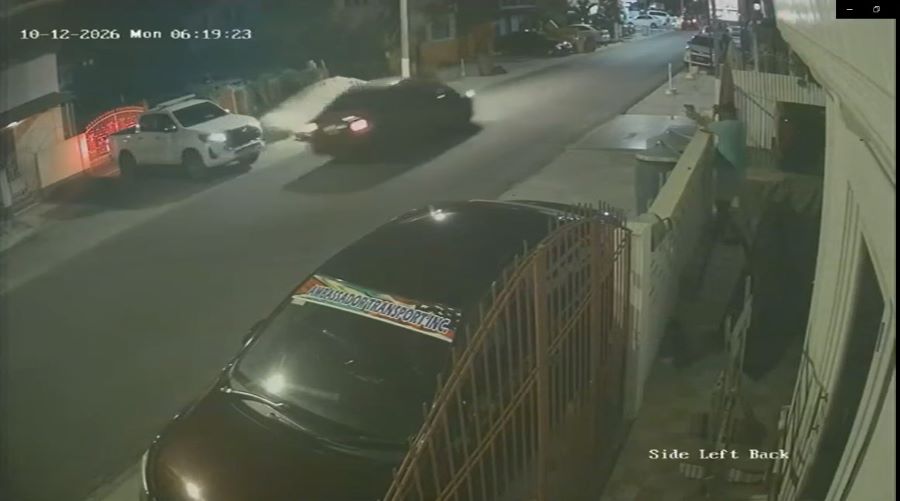
A surveillance video circulating on social media has drawn attention to activity on a narrow residential street, where a dark-colored vehicle passes parked cars and buildings in the early morning.
The recording, approximately eight minutes and 28 seconds long, offers a fixed-camera view of the roadway, its surroundings, and vehicle movements during the period captured.
The footage provides useful visual evidence of possible criminal activity and of the circumstances in which it was recorded.
The video appears to correspond with another video shared by Opposition Leader Azruddin Mohamed. That video shows the person alleged to be Special Branch head Prem Narine, wearing knee-length trousers, traveling in a white vehicle that followed and stopped Mohamed. The occupants of the white vehicle then placed Mohamed and his companions face down on the roadway before arresting them.
What the surveillance camera shows
The video bears a timestamp indicating Monday, October 12, 2026, beginning shortly after 6:11 a.m. The timestamp is accurate only if the DVR system clock was set correctly.
The camera overlooks a relatively narrow street bordered by buildings, parked vehicles, and pedestrian areas.
In the foreground, a dark-colored car is parked behind a metal gate or fence. Across the roadway, a white vehicle sits near a building entrance, illuminated by a bright red light from its rear, possibly brake lights. Additional vehicles appear farther along the street.
Artificial lighting illuminates the road. A subject, who appears to be male and wears a cap, stands behind a fence on the right side of the video. He appears to be looking at something positioned on top of the fence, in or near his left hand, possibly a mobile phone.
Several vehicles pass the location in both directions, and the subject briefly glances at them before returning his attention to the object in or near his left hand.
At 3:15 into the video (timestamped 6:14:55), the subject raises his left hand to his head, possibly holding his phone. Vehicles continue passing in both directions without the subject glancing at them.
At 4:18 (timestamped 6:15:58), the white vehicle’s brake lights extinguish, but the headlights and taillights remain on.
At 4:46 (timestamped 6:16:26), the white vehicle’s brake lights illuminate, and the subject keeps his left hand at his head.
At 4:47 (timestamped 6:16:27), the white vehicle’s brake lights briefly extinguish, and the vehicle begins to exit its parked location. The subject raises his right hand in a gesture that appears to instruct the vehicle to stop. The white vehicle stops, and the subject continues holding his left hand (a phone?) to his head.
At 5:09 (timestamped 6:16:49), the white vehicle’s brake lights extinguish.
At 5:18 (timestamped 6:16:58), the subject lowers his left hand from his head and begins scrutinizing an object in it.
At 5:42 (timestamped 6:17:22), the subject looks left, possibly to see traffic coming from that side of the video, then looks right. A motorcycle passes from right to left and a car from left to right, but the subject is unmoved. He periodically glances at something in or near his left hand.
At 7:08 (timestamped 6:18:48), the white vehicle’s brake lights illuminate.
At 7:36 (timestamped 6:19:16), the subject lowers his left hand to his side, and there appears to be something in his grasp.
At 7:41 (timestamped 6:19:21), a black car emerges into the video from the left.
At 7:42 (timestamped 6:19:22), the subject raises his left hand and grips an object.
At 7:43 (timestamped 6:19:23), a flash appears to emanate from the object in the subject’s left hand. From the recoil of the object, which now appears to be a handgun, four rounds appear to be discharged.
After the shots are fired, the black car slows, and the subject hesitates. Then the black car continues on its way.
The subject exits the yard and signals to the white vehicle as a red car enters the video from the left. He walks back and retrieves an item that was sitting on top of the fence. The white vehicle enters the roadway.
At 8:05 (timestamped 6:19:45), the subject enters the white vehicle through the right rear door, and the vehicle departs the scene with what appear to be law enforcement lights flashing on the roof.
Guyana Police Force report of the incident
The Guyana Police Force’s initial account, as reported by the Guyana Chronicle, said Special Branch head Senior Superintendent Prem Narine heard what sounded like a gunshot, took cover, and fired several rounds from his service weapon toward a black Toyota Allion. Police reported recovering four 9mm casings and one .32-caliber casing. They also reported finding a .32-caliber pistol in the car they later intercepted.
Reporting from the local media
On November 6, News Room reported that prosecutors disclosed photographs, video, and statements in the case against Opposition Leader Azruddin Mohamed, Mario Mohamed, and Eugene Thorne. All three pleaded not guilty.
Guyana’s history of extrajudicial killings
The gunfire in this clip and the history of alleged extrajudicial killings are distinct matters. They raise a shared question: Who investigates those entrusted with state power? In 2024, the United Nations Human Rights Committee found that Guyana had inadequately investigated and prosecuted alleged extrajudicial killings from 2002 to 2006. It urged the government to establish a presidential commission of inquiry and provide redress to victims’ families. The government should publish what it has done since that recommendation, which cases it has reviewed, and when families can expect answers.
If this is the treatment meted out to the Opposition Leader, who, according to his testimony, funded the People’s Progressive Party (PPP) machinery for years and has considerable wealth and other resources, how would an ordinary Guyanese fare?
The international community that lined up and supported the PPP during the 2020 elections must be having second thoughts. The lessons of the early 2000s, when hundreds of deaths went unsolved, were not learned. The assassinations of political activist Courtney Crum Ewing, journalist Ronald Waddell, the Kaieteur Five, Minister of Agriculture Satyadeow Sawh, and many more remain a stain on Guyana.
A maturing country needs mature leadership and people willing to hold its leaders accountable. Can Guyanese make the necessary changes to governance and the rule of law on their own, or do they require intervention from outsiders?
Only Time Will Tell…………….